Average Reviews:

(More customer reviews)The pillows were part of the the sheet set that I got.
Since the pillows are decorative, I didn't wash it before putting it on the bed (I wanted the cripiness of the fabric without the work :-). The pillows were a nice topper to the whole collection. The embroidery on the top is very well done - elevated, smooth with no snags, and the bottom side is cleanly finished. The edges sharp, no excessive puckering.
Just like the hotels.
Great value for this item.
Click Here to see more reviews about: Pinzon 400-Thread-Count Egyptian Cotton Sateen Hotel 18" Decorative Pillow
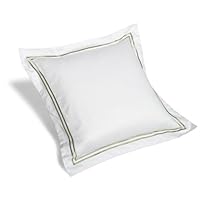
Why shouldn't you outfit your bed with the same sumptuous accessories used in luxury hotels around the world? Enjoy the unrivaled silkiness of pure Egyptian cotton in a 400-thread-count sateen weave. The Pinzon Hotel Satin Stitch decorative pillow has a removable and machine-washable cover expertly made with 150 grams per square meter of single-ply Egyptian cotton yarns. The pillow itself contains a 100-percent feather fill. The white cover features two colored rows of satin stitching to offset a 2-inch flange on all four sides. It is finished with an envelope closure for easy pillow insertion or removal. Available in five versatile satin-stitch colors, the pillow cover is made to coordinate with the Pinzon 400-Thread-Count Sateen Hotel Satin Stitch Collection, but will go with most any Pinzon bedding and home decor. The cover measures 18 by 18 inches, plus the 2-inch flange.
Fabric Definitions Egyptian Cotton: Egyptian cotton is used to make some of the highest quality linens in the world, including sumptuously soft bath and bed linens. Egyptian cotton is grown to produce a longer staple, or fiber, than generic cotton, and the longer and finer a cotton staple is, the better able it is to be spun into finer count yarns, which in turn can be knitted or woven into soft, fine, and luxurious fabrics. The staple length in Egyptian cotton averages 1-1/8 to 1-1/2 inches, but can reach over 2-1/4 inches, which is twice the size of a generic cotton fiber. Products which highlight construction of Egyptian cotton are usually referring to the extra-long-staple cotton produced largely in the Nile River Valley. The humidity and rich soil around the Nile delta produce especially long cotton fibers, which are fine and vary from a light cream to dark tan color. Egyptian cotton is strong, durable and, if cared for properly, will be long lasting.
Sateen: Sateen fabric has a supremely soft, satin-like finish resulting from a four-over-one thread weave. Standard weaves, like percale, use a one-over, one-under stitch. The four-over weave puts more threads nearer the surface, resulting in a softer, warmer surface. Sateen fabrics are most often made of mercerized cotton, but can be made of other fabrics, including cotton blends, polyester, and rayon. Mercerized threads give sateen fabrics a higher luster. Mercerization, named for process-creator John Mercer, involves treating threads with a cold concentrated sodium hydroxide solution. Mercerization also increases strength, dyeability, and resistance to mildew, as well as reduces lint. Sateens can be produced in light and heavy weights, and are ideal for bedding.
 Get 32% OFF

0 comments:
Post a Comment